You did the hard part. The weight came off, your clothes fit differently, and you feel lighter walking up the stairs. Then you catch yourself in a photograph and the face looking back is not quite the one you expected. Flatter through the cheeks. More shadow under the eyes. A jawline that reads tired rather than sharp.
People have started calling this Ozempic face. It is a nickname rather than a medical term, and the nickname is slightly misleading: the change comes mainly from the weight loss, not from a special effect of the medication on your skin. Significant weight loss changes a face, however it is achieved. One likely reason the phrase caught on is that GLP-1 medications have made significant weight loss more common, so more people are noticing the effect.
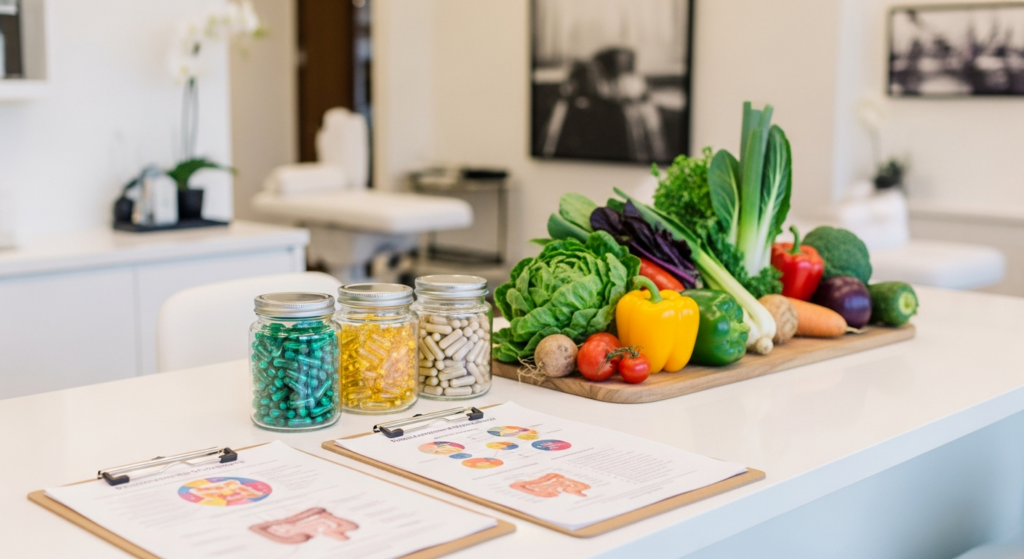
Here is what is happening, why speed can make it more noticeable, and what can help. Some of it is dermal fillers and treatments in the chair. A fair amount of it is what you do while you are still losing.
What is "Ozempic face"?
It is a descriptive nickname for the hollowing and laxity that can show up in the face after fast, significant weight loss. The features people notice most often are flatter cheeks, temples that look slightly sunken, deeper shadow beneath the eyes, more visible folds around the nose and mouth, and a jawline and neck that look softer than they did.
It is worth being precise about the name, because the name causes confusion. As far as is currently understood, the change reflects the weight loss itself rather than a special effect of the medication on the face. Weight loss reduces fat throughout the body, including the face, and with these medications it can happen quickly.
Why does losing weight change your face?
Your face is not a flat surface stretched over bone. It is built in layers, and one of those layers is a set of discrete fat compartments, sometimes called fat pads, that sit in predictable places across the cheeks, temples and around the mouth and eyes.
Those compartments do a lot of quiet work. They give the midface its forward projection, they keep the transition from the lower eyelid to the cheek smooth, and they support the skin above them so it sits rather than drapes. A face that reads as rested and healthy is usually a face with its volume in the right places.
When your body draws on fat stores, it does not exempt the face. The compartments get smaller along with everything else. Lose enough and two things happen at once: the support underneath reduces, and the skin that used to cover it now has more surface area than it needs. That combination is what produces hollowing in some areas and softness in others at the same time.
Skin elasticity matters here too, and it is partly a question of age. Skin in your twenties recovers from a volume change more readily than skin in your fifties, which has less collagen and less elastin to work with. The same amount of weight loss can look quite different on two people for reasons neither of them controls.
Is it the medication or the weight loss?
Mostly the weight loss. The same facial changes have long been recognized in people who lost substantial weight through surgery, through illness, or through diet and exercise alone. Nothing about it is new.
What GLP-1 medications changed is the pace and the scale. Medical weight loss can lead to significant weight loss over a relatively short period, and a face given less time to adapt can show the change more plainly. Results vary.
There is a second factor that has less to do with the drug than with how some people go about losing weight on it, and it is the one most worth your attention.
Why does rapid weight loss make it more obvious?
Because of what you lose alongside the fat.
Substantial calorie restriction typically costs some lean tissue as well as fat. How much can depend on several things, including whether you are eating enough protein and whether you are asking your muscles to do anything. GLP-1 medications reduce appetite, which is the point, but a much smaller appetite makes it harder to hit a protein target without planning for it. Some people lose weight quickly on very little protein and no resistance training, and may lose more lean tissue than they need to.
Losing lean tissue matters for more than your face. It can show up in your strength, in how you feel, and in how easy the weight is to keep off afterwards. This is a part of the picture a purely aesthetic conversation can miss, and it is where a functional medicine view can be useful rather than an add-on. Protein intake, iron and B12 status, thyroid function, sleep and training load can all play a role.
If you are still losing, this is worth acting on, because protecting lean tissue while you lose is generally easier than restoring volume later.
What can you do while you are still losing?
Four things to consider, in rough order of how much they tend to matter. Check with your provider before changing your diet or starting a new exercise routine.
Eat enough protein, deliberately. With a suppressed appetite this does not tend to happen by accident. It usually takes planning, such as front-loading protein earlier in the day, and some people use shakes to close the gap.
Do resistance training. You do not need a complicated program. You need to load your muscles regularly enough that your body has a reason to keep them.
Talk to your provider about pace. Faster is not automatically better. A slightly slower rate of loss may give skin more time to accommodate and may be easier on lean tissue. Any change to your dose or schedule is a decision for your prescriber.
Support the skin itself. Sun protection, a barrier-focused routine and not smoking can all influence how well skin holds its structure. None of this is dramatic and all of it compounds.
Which treatments can restore facial volume?
Once the weight is stable, the question becomes what is worth restoring and in what order. A few categories do different jobs.
Biostimulators work by prompting your own collagen production over a period of months rather than filling a space directly. That can make them a good fit for the diffuse, all-over flatness that can follow weight loss, because the aim is to rebuild general support rather than change one feature. Sculptra is one example. Results build gradually and vary from person to person.
Hyaluronic acid fillers can be a good choice when a specific area needs structure now: midface projection, temples, a jawline that has lost definition. Used well the goal is support and proportion rather than volume for its own sake, which is the thinking behind facial balancing.
Skin tightening and resurfacing can address the quality of the envelope rather than what sits under it. Where laxity and texture are the main complaint rather than hollowing, treatments such as skin tightening are designed to address that layer.
Many people who are unhappy with their face after weight loss end up considering a combination of treatments, sequenced over time, rather than a single one. What that combination looks like is a conversation with a provider who has seen your face, not something to decide from an article. Results vary from person to person.
When is the right time to treat?
Generally once your weight has been stable for a while. Restoring volume into a face that is still actively changing means chasing a moving target, and you may end up paying twice.
The exceptions are skin quality work, which your provider may be happy to start at any point, and the internal work, which tends to matter most while you are still losing.
What this is not
This is not a reason to avoid GLP-1 medications, and it is not a reason to stop one without talking to the provider who prescribes it. Decisions about your medication belong with your prescriber, and changes to your face are one of several things worth discussing with them.
It is also not a claim that treatment returns your face to an earlier version of itself. The realistic goal is restoring support and proportion so your face looks rested and like you, at the weight you are now.
And it is not a diagnosis. Facial changes after weight loss are common. If something else has changed, that is worth raising with a provider rather than treating cosmetically.
Where should you start?
If you are still losing, start with protein, resistance training and a conversation about pace. That is a good place to start, and it does not require any treatment.
If your weight is stable and the face in your photographs is bothering you, start with an assessment rather than a treatment. The useful first question is which part of what you are seeing is lost volume, which part is skin quality, and which part is worth leaving alone. If you have also been feeling flat, tired or foggy through the process, it is worth looking at what a standard lab panel can miss at the same time, because the answers can overlap.
Join our waitlist
If this sounds like what you have been experiencing, you can join the waitlist for functional health care at Hamilton Aesthetics in Palm Beach Gardens, and the practice will be in touch.
This article is for education and is not medical advice. Talk with your own provider about your situation.
About the Author
Bianca Somers, PA-C
Nationally certified physician assistant with advanced training in aesthetic medicine, plastic surgery, and wellness-based care. She specializes in aesthetic injectables, including neuromodulators and dermal fillers, as well as skin rejuvenation and laser treatments. Bachelor of Science in Microbiology from the University of Florida and Master of Physician Assistant Studies from Nova Southeastern University, with continued education in wellness medicine including hormone optimization therapies.