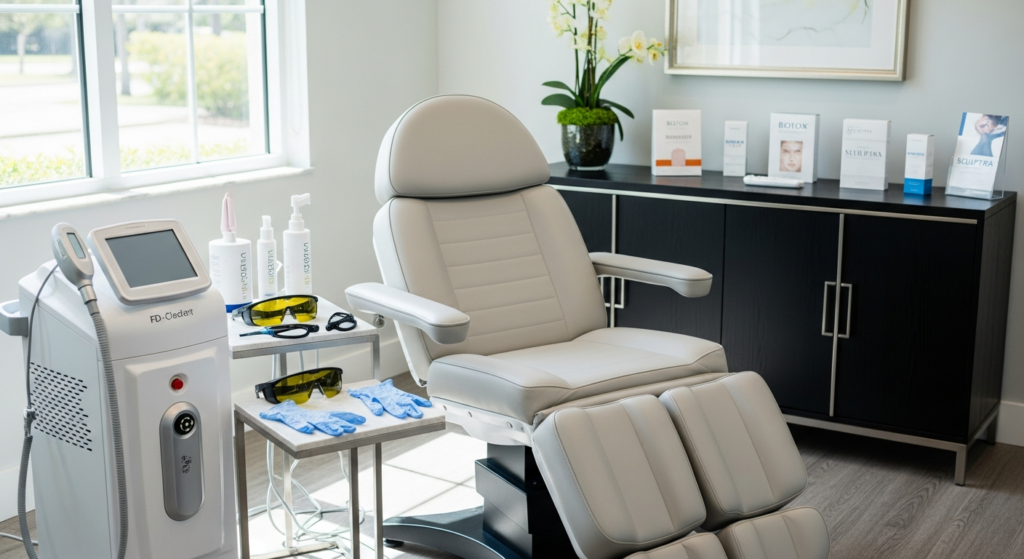
Most people meet a medical spa through one door. They come in for tox before a wedding, for filler that softens a line that has started to bother them, for a facial because their skin has lost its brightness. The work is good, they like the result, and they come back.
Then something shifts. The results do not hold quite as long as they used to. Skin that used to bounce back takes longer. Breakouts arrive in a decade nobody warned them about. Hair that was thick is noticeably less so in the brush. Nothing is wrong exactly, but the same treatments are working harder for less.
That is usually the point at which the interesting question stops being which treatment and starts being what changed. It is also the point where aesthetic medicine and functional medicine stop being two separate departments and start being one conversation.
Why do skin and hair reflect what is happening internally?
Skin and hair are demanding tissues. They turn over constantly, and doing that well requires steady raw materials: protein, iron, zinc, essential fats, B vitamins. It also requires reasonably stable hormones, a functioning thyroid, blood sugar that is not swinging wildly, and a body that is not carrying a heavy inflammatory load.
When any of that becomes strained, skin and hair are among the first places the body economizes. They are not essential to survival in the way your heart and brain are, so they are early to lose resources and late to get them back. That is inconvenient if you care how you look, and genuinely useful if you are trying to understand what is going on.
It is why a dermatologist and a functional medicine provider can look at the same face and see two true things at once. The surface is real. So is the reason it changed.
What do aesthetics and functional medicine each actually do?
They answer different questions, and confusing them is where people get frustrated.
Aesthetic treatment addresses how your skin looks and behaves now. Resurfacing, biostimulators, injectables, medical facials and device based treatments change texture, tone, volume and collagen. These are direct interventions with well understood mechanisms, and they work. Nothing in this article is an argument against them.
Functional medicine addresses the conditions your skin is operating under. Hormones, thyroid function, iron and nutrient status, blood sugar regulation, gut health, sleep and stress load. It does not treat a wrinkle. It looks at why the skin is behaving the way it is between appointments.
One is what you do to the tissue. The other is the environment the tissue lives in. Doing the first while ignoring the second is not wrong, it is simply working against a headwind you cannot see.
Which visible changes usually have an internal explanation?
Some of the most common complaints people bring to an aesthetic practice have a pattern behind them that is worth investigating.
Adult acne along the jaw and chin. Breakouts that arrive or return in your thirties and forties, particularly clustered along the lower face and often tracking with your cycle, frequently have a hormonal component. Topical treatment can help the lesion in front of you. It does not address the reason a new one appears next month.
Hair thinning and increased shedding. Among the most common reasons people quietly panic, and among the most commonly missed. Iron stores can be substantially depleted while a standard blood count reads as entirely normal, and thyroid function affects the growth cycle directly. Both are identifiable once somebody looks specifically.
Dullness and slower healing. If recovery from treatments is taking longer than it used to, or skin looks flat regardless of what you put on it, protein intake, nutrient status and blood sugar stability are all worth examining before concluding that the treatment underperformed.
Skin that reacts unpredictably. Flushing, sensitivity or flares that do not track with anything obvious in your routine often relate more to inflammation, gut health or stress than to the product you changed last week.
Changes that arrived together. The most telling pattern of all. When skin, hair, energy, sleep and mood shifted around the same period, that is rarely five separate problems. It is usually one upstream change with five visible consequences.
Does treating the inside make aesthetic treatments work better?
This deserves an honest answer rather than a marketing one.
There is no guarantee, and anyone promising you one is overselling. What can be said is that aesthetic treatments rely on your body’s own repair processes to deliver their result. Resurfacing works because skin heals afterwards. Biostimulators work because your body responds by producing collagen. Those processes require nutrients, adequate protein, decent sleep and manageable inflammation.
So it is reasonable, and consistent with what providers observe, that treatments generally perform better when the body carrying them out is well resourced. Many patients report that results feel more durable once the internal picture has been addressed. Individual results vary from person to person, and your provider will set expectations against your own situation rather than a general claim.
The more reliable framing is this. Functional medicine will not make a treatment do something it does not do. It removes the drag that makes a good treatment underdeliver. Hamilton’s functional medicine program is organized by area of focus, so you can read about the one that matches your picture.
Who benefits most from combining the two?
Three groups tend to get the most from it.
People whose results stopped lasting. If the same treatment on the same schedule is delivering less than it did two years ago, something changed, and it is worth finding out what.
People in a hormonal transition. Perimenopause in particular changes skin, hair, sleep, mood and body composition simultaneously. Treating only the visible part of that is treating a symptom of something much broader.
People who already sense the connection. Plenty of patients arrive already saying some version of “I do not think this is only my skin.” They are usually right, and they are usually the ones who have been told everything looks normal.
What does this look like in practice at Hamilton?
At Hamilton Aesthetics in Palm Beach Gardens the two run alongside each other rather than as separate tracks.
You might continue the aesthetic treatments you already come in for, while a functional consultation looks at what is happening underneath. That consultation is unhurried and covers sleep, energy, cycle, mood, digestion, medications and what your days actually look like. Testing is chosen from that conversation rather than ordered from a fixed panel, and you sit down afterwards to go through every result and what it means.
Functional care is led by Bianca Somers, PA-C. Nothing about it requires you to stop or pause the aesthetic services you value, and it is not a replacement for care you receive elsewhere. Your provider will never recommend stopping a prescribed medication without involving whoever prescribed it.
Where should you start?
If your skin and hair are telling you something and you would rather understand it than keep managing it, start with a conversation. If you are happy with your results and simply want to keep them, there is nothing you need to change.
Feeling good in your skin has always been the point. The surface work and the internal work are two routes to the same place, and they are considerably more effective travelled together. Book a functional medicine consultation at Hamilton Aesthetics in Palm Beach Gardens and let us look at the whole picture. Results vary from person to person.
Join our waitlist
If this sounds like what you have been experiencing, leave your name, phone and email and the practice will be in touch about functional health care at Hamilton Aesthetics in Palm Beach Gardens.