
Choosing the right clinic for laser hair removal is one of the most important decisions you will make on the way to permanent hair reduction. The provider you select directly affects your safety, your comfort, and your results. Unlike temporary hair removal methods, laser treatments require specialized equipment, medical training, and multiple sessions over several months. A qualified provider working with FDA-cleared technology is far better positioned to deliver safe, effective results, though results always vary by individual. In inexperienced hands, the risks are real: the American Academy of Dermatology notes that burns, permanent changes in skin color, and scarring can occur.
This guide walks you through what to look for when choosing a laser hair removal clinic, from provider qualifications to technology standards. Whether you are researching your first treatment or thinking about switching providers, you will find the specific questions to ask and the red flags worth walking away from.
What Should You Look for When Choosing a Laser Hair Removal Clinic?
When choosing a laser hair removal clinic, prioritize three things: qualified medical providers with proper training and licensure, FDA-cleared laser technology appropriate for your skin type, and a consultative approach with no high-pressure sales tactics. Beyond that, look for a clinic that maintains strict safety protocols, offers a thorough consultation before treatment, and can show you authentic before-and-after results from patients with skin tones and hair types similar to yours.
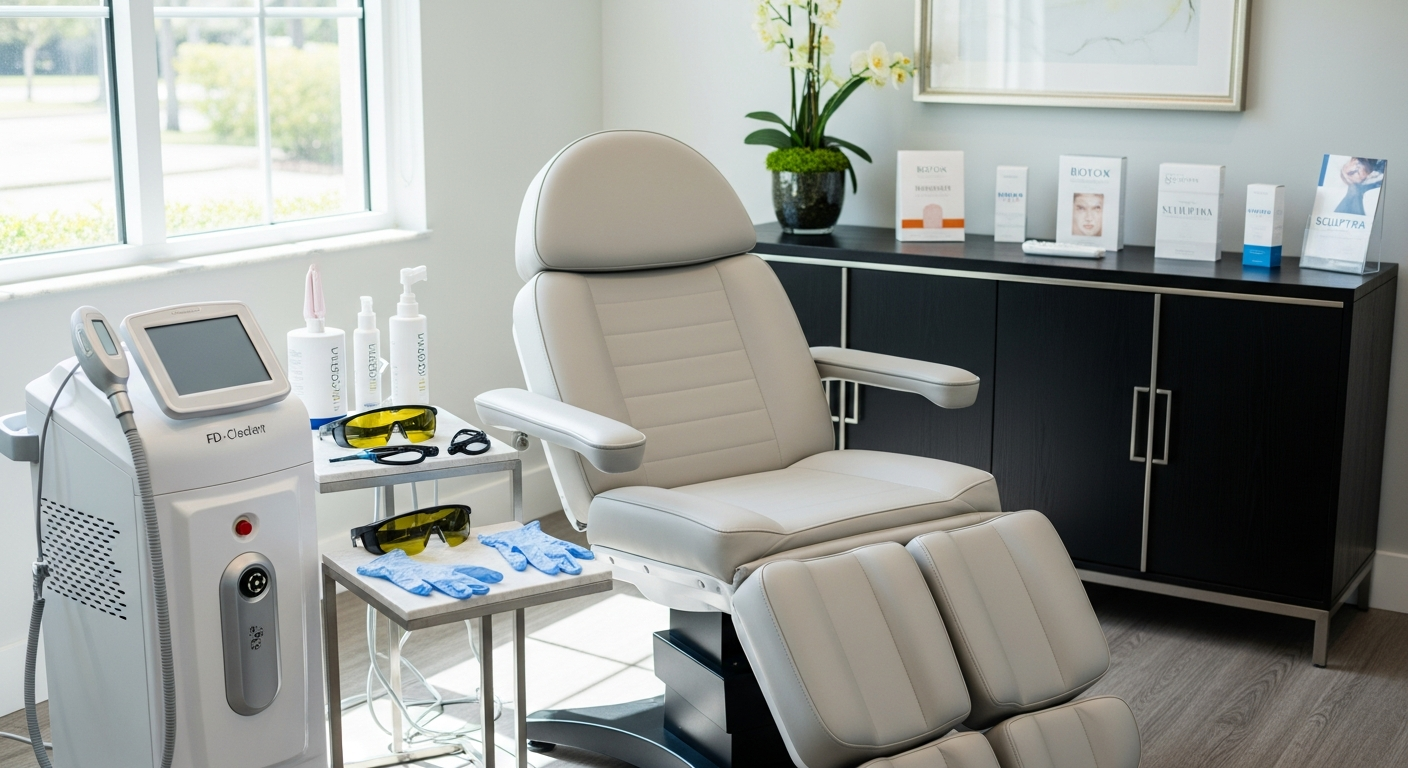
The physical environment matters too. A reputable clinic maintains a clean, professional space that feels medical rather than purely retail. You should see proper sterilization practices, sanitized or single-use applicator tips, and clear emergency procedures. The clinic should complete a comprehensive consultation before any treatment, reviewing your medical history, current medications, recent sun exposure, and skin sensitivity. That is not just good service. It is how a provider decides whether laser treatment is appropriate for you at all.
Technology is the next consideration. Laser hair removal works by targeting melanin, the pigment in your hair, which means the wavelength and the settings have to suit your skin tone and hair color. Different systems have different strengths across the Fitzpatrick skin tone scale (types I through VI), so what matters is not a long device list on a website but whether your provider can explain, in plain language, why the device and settings they plan to use are appropriate for your skin. A clinic that cannot answer that question has not done the assessment.
Continuing education is worth asking about. Laser technology and protocols keep evolving. Providers should maintain their training, keep current with device guidance and clinical best practice, and be willing to tell you how recently they trained on the specific system they will use on you. Manufacturers such as Candela, Cynosure, and Lumenis all provide formal clinical training programs on their systems, and a provider who has completed the training for your device should be happy to say so.
Finally, pay attention to how a clinic sets expectations. Reputable providers explain up front that a series of sessions is necessary, because the laser only affects hair that is actively growing. They should never pressure you to commit on the spot or suggest you will be finished after one or two visits.
What Qualifications Should Laser Hair Removal Providers Have?
Laser hair removal is regulated as a medical service, and the rules are set state by state. In Florida, laser and light-based hair removal may only be performed by a licensed physician (MD or DO), or, under the direct supervision and responsibility of a physician, by a physician assistant, an advanced practice registered nurse, or a licensed electrologist who holds the state's laser and light-based hair removal qualification. Florida law does not permit estheticians or cosmetologists to perform laser hair removal. The requirement sits in Florida Statutes section 458.348 and in the Board of Medicine's rules, and limited exceptions exist, including offices where laser hair removal is the exclusive service provided by an advanced practice registered nurse or physician assistant.
Rules vary significantly from state to state. Some states allow only a physician, or someone working under a physician's supervision, to perform laser hair removal. Others permit licensed electrologists, laser technicians, or specifically trained estheticians to do so. Florida sits on the stricter end, which is worth knowing if you are comparing a clinic here against one you used in another state.
Specific credentials to verify include state licensure (searchable through the Florida Department of Health license portal), documented training on the specific laser system your provider will use, and, ideally, membership in a professional body such as the American Society for Laser Medicine and Surgery or the American Society for Dermatologic Surgery. Board-certified dermatologists and plastic surgeons represent one high level of training for aesthetic laser procedures, and many physician assistants and nurse practitioners hold extensive, device-specific laser training and perform these treatments at high volume. What matters most is documented, ongoing training specific to laser hair removal and to the device in the room.
Red flags include a provider who cannot or will not show you their license, credentials that cannot be verified with the issuing body, and anyone whose licensure level is not permitted to perform the procedure in your state. Asking is reasonable, and verifying independently through the state licensing board is entirely appropriate.
How Do You Know If a Laser Hair Removal Clinic Is Reputable?
A reputable laser hair removal clinic demonstrates transparency through verifiable credentials, authentic patient results, clear safety protocols, and honest conversation about realistic outcomes. Check the clinic's standing with the state medical board, confirm the business is licensed, read reviews across several platforms looking for patterns rather than outliers, and confirm the specific device is FDA-cleared for permanent hair reduction.
Professional affiliations signal credibility. Recognition from device manufacturers, such as a Center of Excellence designation, generally requires meeting defined training and safety standards, and active memberships in professional medical societies come with continuing education requirements. We wrote more about how to read those signals in our guide to what actually sets a top-rated medical spa apart.
Online reviews are useful when read critically. One negative review tells you little. A pattern tells you a lot: repeated mentions of burns, ineffective treatment, hidden fees, or pressure to buy. Authentic positive reviews tend to name specific staff, describe the consultation, and set realistic expectations about how many sessions were needed.
Ask to see a portfolio of before-and-after photos covering a range of skin tones and treatment areas. Look closely: credible photos show the same patient in the same lighting, with realistic improvement across a series of sessions rather than a dramatic overnight change. A clinic that carries appropriate medical liability coverage will confirm it without hesitation, and evasiveness about licensing, credentials, or insurance is a reason to keep looking.
Visit before you commit. Treatment rooms should be clean and well maintained, protective eyewear should be in use during procedures, and sanitation between patients should be visible rather than assumed.
What Questions Should You Ask Before Choosing a Laser Hair Removal Clinic?
Before choosing a laser hair removal clinic, ask these essential questions: what are the credentials of the person performing my treatment, what specific laser system will be used and is it FDA-cleared for my skin type, how many sessions will I likely need, what are the risks specific to my skin tone and hair color, and what happens if I have a complication or I am unhappy with my results.
Provider credentials and experience:
- What is your license type, and may I verify it independently?
- How long have you been performing laser hair removal?
- How much training have you completed on this specific laser system?
- How often do you treat patients with my skin tone?
Technology and safety:
- What laser system do you use (brand and model)?
- Why is this system and setting appropriate for my skin type on the Fitzpatrick scale?
- Is the device FDA-cleared for permanent hair reduction?
- When was it last serviced and calibrated?
- What safety protocols do you follow during treatment, including eye protection and cooling?
Treatment expectations and protocols:
- How many sessions do you expect I will need, and why?
- What should I expect during treatment in terms of sensation and duration?
- What pre-treatment and post-treatment care is required?
- What results are realistic for my hair color and skin type?
- How long do results typically last, and will I need maintenance sessions?
Complication management:
- What side effects should I watch for, and when should I call you?
- How do you handle complications such as burns, pigment changes, or paradoxical hair growth?
- Is follow-up care included if something goes wrong?
How a provider answers matters as much as the answers themselves. Reputable providers answer thoroughly and without defensiveness. They acknowledge that results vary from person to person, that some risk always exists even when technique is excellent, and that realistic expectations are part of good care. Evasive answers, pressure to commit on the spot, or dismissiveness about your concerns are all meaningful signals.
The Difference Between Medical Spas and Dermatology Clinics for Laser Hair Removal
Both medical spas and dermatology clinics can provide safe, effective laser hair removal when they are properly qualified and equipped. Medical spas typically focus on aesthetic treatments and may offer more flexible scheduling, while dermatology clinics are full medical practices where laser treatment is one service among comprehensive skin care. The meaningful difference is not the setting. It is whether appropriately licensed professionals perform the procedure under the supervision your state requires.
At a medical spa, treatments are often performed by physician assistants and nurse practitioners who work in aesthetics full time and perform these procedures at high volume. Dermatology clinics offer the advantage of board-certified dermatologists who can also address medical skin conditions, which matters if you have active eczema, psoriasis, or a mole that needs evaluation. In practice, the laser itself is often held by the same credential levels in both settings.
Understanding Laser Technology and Skin Type Compatibility
Not every laser suits every skin tone, which is why device and setting selection drive both safety and results. Laser hair removal targets melanin in the hair follicle, but melanin is also present in the surrounding skin, so a wavelength that works well on light skin with dark hair can risk burns or pigment change on deeper skin tones. A qualified provider assesses your skin on the Fitzpatrick scale (types I through VI) and matches wavelength, energy, and cooling accordingly.
Alexandrite lasers (755nm) are well suited to lighter skin tones (Fitzpatrick I to III) with dark hair, offering fast treatment times. They carry a higher risk of burns and pigment change on deeper skin tones, which is why settings and operator experience matter so much.
Diode lasers (800 to 810nm) penetrate deeper with less epidermal impact and are used safely across a broad range of skin types, generally I through V with appropriate settings. They are among the most commonly used systems for hair reduction.
Nd:YAG lasers (1064nm) are generally preferred for deeper skin tones (Fitzpatrick IV to VI). The longer wavelength passes more readily through surface melanin, which lowers the risk of pigment change, though treatment may require more sessions to reach the same reduction.
IPL (Intense Pulsed Light) is not a laser but a broad-spectrum light device, and it is a different tool for a different job. IPL excels at pigment and redness, which is why it is the basis of an IPL photofacial. For hair reduction specifically, a systematic review of the long-term evidence found support for lasting hair reduction with alexandrite and diode lasers, while evidence for long-term reduction with IPL was lacking at the time. Newer IPL devices have narrowed that gap and some patients tolerate IPL well, but for hair reduction a dedicated laser is the more established choice.
It is also worth knowing what "permanent hair reduction" actually means, because it is the term the FDA uses in device clearances rather than a marketing phrase. In FDA clearance documentation, permanent hair reduction is defined as a long-term, stable reduction in the number of hairs regrowing, measured at 6, 9, and 12 months after a course of treatment. It means significantly less hair that grows back finer and lighter. It does not mean every hair is gone forever, and any clinic promising that is overselling.
Whatever the device, your provider should be able to explain which system they are using and why it fits your skin, and should discuss how they will manage the risk of pigment change if your skin tone puts you at higher risk.
Red Flags That Signal You Should Choose a Different Clinic
Some warning signs are worth acting on immediately: a provider who cannot or will not show credentials, devices that are not FDA-cleared, poor cleanliness or no visible safety protocols, high-pressure sales tactics or large mandatory upfront payments, and anyone who promises permanent removal after one or two sessions or guarantees your outcome.
Other concerning signs include a provider who never assesses your skin type, staff who seem unfamiliar with the specific system, a clinic that will not discuss how complications are handled, and reviews that repeatedly mention burns, ineffective treatment, or billing problems.
Trust your instincts. If you feel rushed, or the space does not feel clean and professional, it is completely reasonable to walk away and keep looking. This is a medical treatment on your skin, and you deserve a provider who earns your confidence through transparency and expertise.
Frequently Asked Questions
How many sessions does laser hair removal typically require?
At Hamilton Aesthetics, most people need a series of 6 to 8 sessions spaced 4 to 8 weeks apart, because the laser only affects follicles in the active growth phase and your hair cycles through that phase at different times. Some patients need maintenance sessions afterward, generally every 6 to 12 months. Published estimates vary, and your own plan depends on the treatment area, your hair color and thickness, hormonal factors, and how your body responds. Your provider sets that plan at your consultation, and results vary.
Can laser hair removal be performed safely on deeper skin tones?
Yes, with the right wavelength and settings. Longer-wavelength devices, particularly Nd:YAG, are generally preferred for Fitzpatrick types IV to VI, and diode systems are used across a wide range of skin types. That said, deeper skin tones carry a higher risk of pigment change, blistering, and scarring, so device selection, conservative energy settings, cooling, and provider experience genuinely matter. This is the single most important question to ask if you have a medium or deep skin tone, and a provider who does not raise it before treating you has skipped a step.
What should I do if I have a problem after treatment?
Mild redness and swelling similar to a light sunburn are normal for the first few hours and sometimes for a day or two, and treated hairs typically shed over the following 1 to 3 weeks. Contact your provider promptly if you have severe pain, blistering, significant swelling, signs of infection, or pigment changes that worsen rather than settle. A reputable clinic gives you clear aftercare instructions and a way to reach someone if you need to.
Can estheticians legally perform laser hair removal in Florida?
No. Florida limits laser and light-based hair removal to physicians, and to physician assistants, advanced practice registered nurses, and specially qualified licensed electrologists working under a physician's direct supervision and responsibility. Estheticians and cosmetologists are not authorized to perform it here. Other states draw the line differently, so if you are comparing clinics across state lines, check the rules where the treatment will happen.
How do I verify that a laser system is actually FDA-cleared?
Ask for the brand, model, and FDA clearance number, then search the FDA's 510(k) Premarket Notification database by device or manufacturer name. Reputable clinics share this readily. Be cautious of vague claims that a facility is "FDA-approved," since the FDA clears devices, not clinics.
How Hamilton Aesthetics Approaches Laser Hair Removal
At Hamilton Aesthetics in Palm Beach Gardens, our laser hair removal treatments are performed using FDA-cleared technology, with settings tailored to your skin type, hair color, and treatment area. The practice was founded by Stephanie Hamilton, PA-C, a national injection trainer for Galderma with a background in family medicine and military service, and the conservative, safety-first approach she built runs through every service, including our wider range of laser and light-based treatments.
Your visit begins with a consultation. Your provider reviews your medical history and current medications, assesses your skin and hair, talks through what is realistic for your skin tone and hair color, and builds a treatment plan around it. Preparation matters as well: shave the area the night before or the morning of your appointment, and avoid waxing, plucking, and tweezing for at least six weeks beforehand, since the hair root needs to be intact in the follicle for the laser to work.
The philosophy is honest guidance and natural results. You will not be pressured into treatments or packages that do not serve your goals. A boutique setting where you are treated as an individual rather than a transaction is what we aim for on every visit. If you are curious how the same principles apply to other laser services, our guide to laser resurfacing in Palm Beach Gardens covers that side of the menu.
If you are considering laser hair removal in Palm Beach Gardens or the wider Palm Beaches, a consultation is the place to find out whether you are a good candidate for permanent hair reduction and what your plan would realistically involve.
Ready to talk it through with a qualified, experienced team? Contact Hamilton Aesthetics at (561) 366-7772 or schedule your consultation. We are at 3399 PGA Blvd, Suite 450, Palm Beach Gardens, FL 33410.
Join our newsletter for expert insights on aesthetic treatments, skincare, and wellness delivered to your inbox each month.
About the Author
Bianca Somers, PA-C
Nationally certified physician assistant with advanced training in aesthetic medicine, plastic surgery, and wellness-based care. She specializes in aesthetic injectables, including neuromodulators and dermal fillers, as well as skin rejuvenation and laser treatments. Bachelor of Science in Microbiology from the University of Florida and Master of Physician Assistant Studies from Nova Southeastern University, with continued education in wellness medicine including hormone optimization therapies.